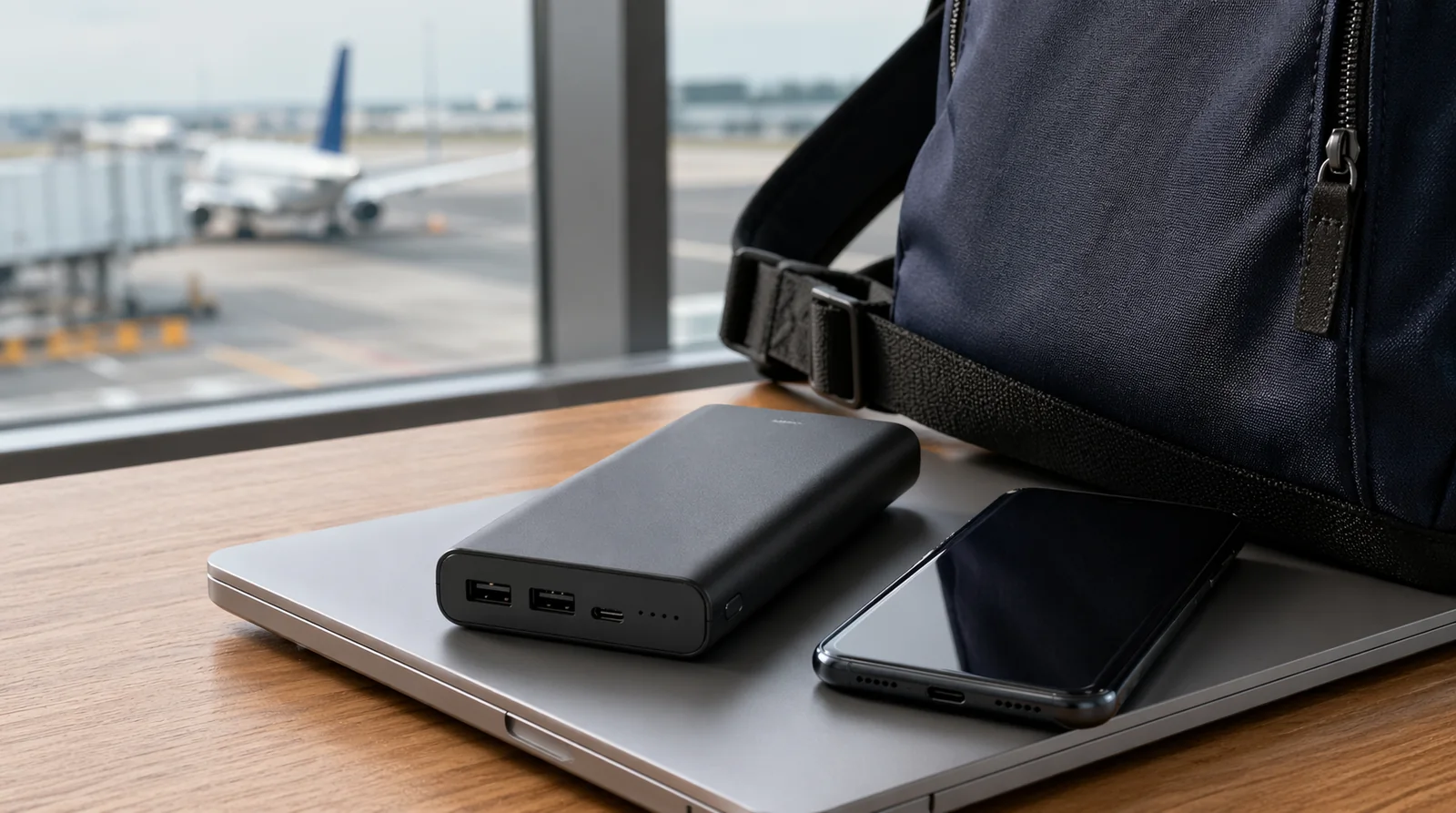

Finding yourself in a new city or country with a dead phone, frantically searching for an outlet, isn’t a practical way to start a trip. That’s why a portable charger is a real lifesaver - it lets you charge your gadgets. However, some models are not allowed on board an airplane, and travellers may be asked to leave them behind during security screening. it’s a good idea to familiarize yourself with power bank flight rules before the trip to avoid unpleasant surprises.

Carry-On vs Checked Baggage Rules
The airline power bank rules aren’t always the same. verify you review all the details before your flight and familiarize yourself with the basic guidelines for different types of luggage.
| Aspect | Carry-On Baggage | Checked Baggage | Description |
| Availability | Always at hand | Not available during flight | Can be quickly accessed and used in the cabin |
| Safety | Crew can respond promptly | No control | Difficult to detect and resolve issues in the cargo hold |
| Usage | Can charge gadgets during the flight | Not possible | The device is inaccessible in checked baggage |
| Risks | Minimized thanks to monitoring | High: overheating, fire | That is why it is prohibited to carry in checked baggage |
Some airlines, particularly in Asia, have much stricter rules for transporting external batteries. At certain airports, power banks without clear labeling or with damaged casings may be confiscated during security screening.
Power Bank Carry-On Rules and Capacity Limits
According to IATA regulations and the policies of most airlines, portable chargers may only be carried in carry-on luggage. They are not permitted in checked baggage. The allowed capacity depends on the battery’s capacity.
The capacity limits are as follows:
- up to 100 Wh (approximately 27,000 mAh at 3.7 V) - permitted without restrictions, most power banks fall into this category;
- from 27,000 to 43,000 mAh - sometimes permitted, but only after approval from the airline;
- over 43,000 mAh - cannot be carried on board.
Before your flight, travellers should check your device’s battery life and confirm the rules of the airline you’re flying with.
How to Check Wh / mAh on a Device
When choosing a portable charger for travel, travellers should look not only at the mAh rating but also at the power in Wh - this is the parameter that airports check. use the formula: Wh = (mAh × V) ÷ 1000 to determine whether your device complies with the rules.
for instance, a 20,000 mAh power bank with a voltage of 3.7 V has 74 Wh - travellers can take this one on board without restrictions. However, if there is no label or the capacity exceeds 160 Wh, the device will not be allowed on board. Therefore, always check this information before your trip.
And here’s another important tip for traveling with a power bank. Don’t buy cheap devices of questionable quality. In practice, they might fail you when you need them most and could even be dangerous.
Packing and Safety Tips
First, verify the capacity of your portable device is listed in watt-hours. This is a security screening parameter that can vary even within the same airline alliance. Keep the device in your carry-on luggage so it’s within easy reach. Don’t hide it at the bottom of your bag. For safety, use a special case that protects the device from accidental short circuits.
Instead of one large battery, bring 2 compact ones. This reduces risks and gives you more flexibility in use. In real-world use, and if you’re planning a trip with photography equipment, a sensible approach is to have separate batteries for your camera, as it makes shooting more convenient and can help travellers pass security without any issues.
Comments
No comments yet.